What is the OBD-II port?
The OBD-II port is also called the DLC (Data Link Connector). It is the socket the scanner plugs into. The scanner gets its power from this port and talks to the car's ECU through it. Its shape and pin numbers are fixed by the SAE J1962 standard, so the port is the same on every OBD-II car.
- 16 pins in two rows: 8 on top and 8 below.
- D shape: wider at the top, narrower at the bottom, so the plug cannot go in upside down.
- The car has the female socket; the scanner cable has the male plug.
Where to find the port
Check these places in order:
- Driver side, under the steering, in the lower dashboard panel. Most cars have it here.
- Near the fuse box, or behind the fuse box cover.
- In the center console, near the gear lever or behind a small cover.
- Under the dashboard on the passenger side (some models).
How to count the pins
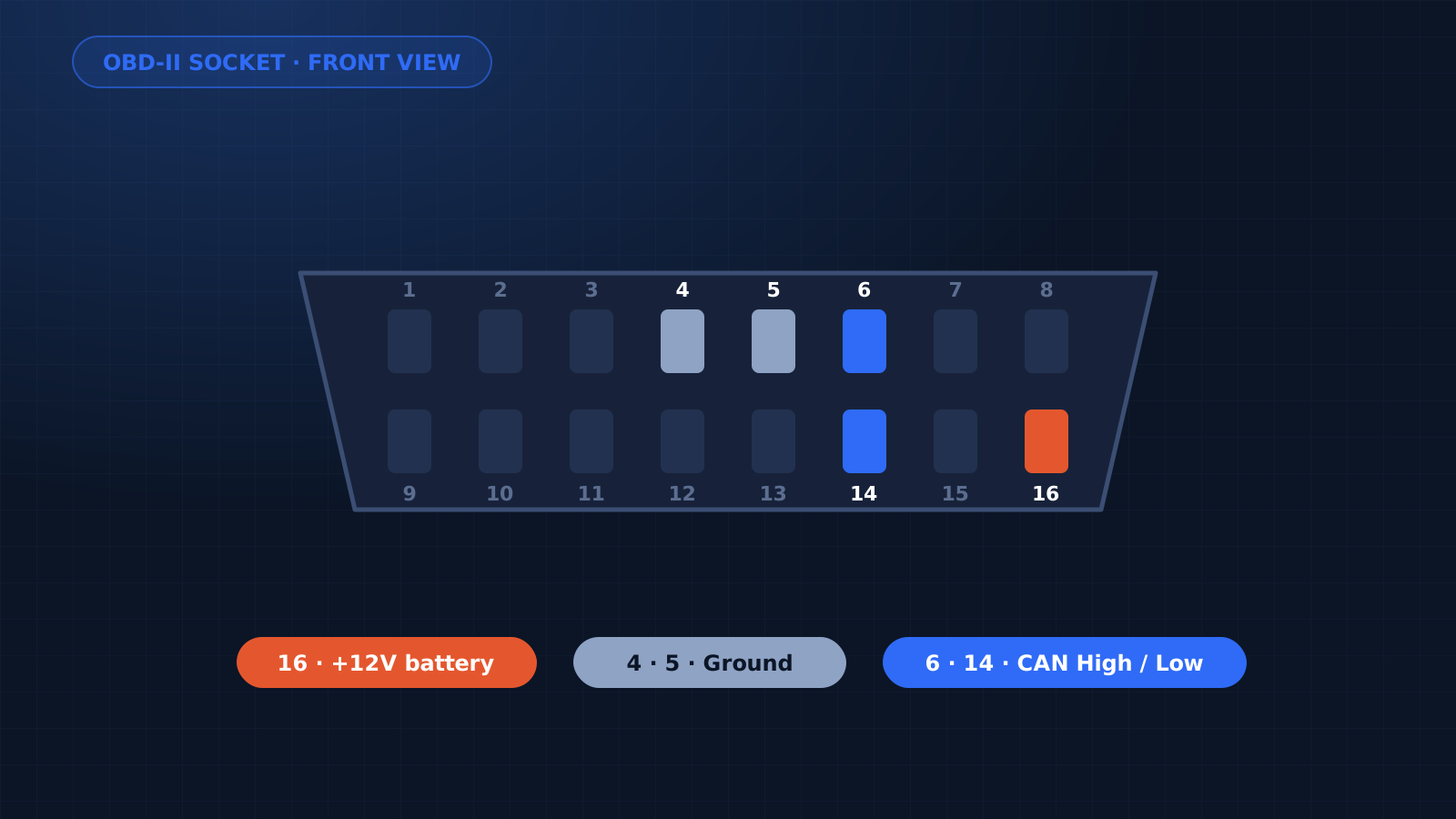
Look at the car socket from the front with the wide side on top. The top row is pin 1 to 8 from left to right, and the bottom row is pin 9 to 16 from left to right. If you look at the scanner plug, or at the socket from the back (wire side), the order is reversed and pin 1 is on the right. Always count from the front of the socket.
All 16 pins
Pins marked OEM are left to the car maker. They can carry a separate ABS, airbag or body module data line, a second CAN line or an ignition supply. Check the wiring diagram of that car to see what is on them.
- Pin 1, 3, 8, 9, 11, 12, 13: OEM, manufacturer use.
- Pin 2: J1850 Bus +, older American cars (PWM / VPW).
- Pin 4: Chassis ground, the car body ground.
- Pin 5: Signal ground, clean ground from the ECU side.
- Pin 6: CAN High (ISO 15765-4).
- Pin 7: K-line (ISO 9141-2 / KWP2000).
- Pin 10: J1850 Bus −, only on J1850 PWM.
- Pin 14: CAN Low (ISO 15765-4).
- Pin 15: L-line (ISO 9141-2 / KWP2000, on some cars).
- Pin 16: Battery +12 V, direct battery supply, live even with the key OFF.
Protocols and their pins
A protocol is the way the ECU and the scanner talk to each other. OBD-II has 5 protocols, and each one uses fixed pins.
- ISO 15765-4 (CAN): pins 6 and 14. Almost all cars after 2008.
- ISO 14230-4 (KWP2000): pin 7 (and 15). Older Asian and European cars.
- ISO 9141-2: pins 7 and 15. Older Asian and European cars.
- SAE J1850 PWM: pins 2 and 10. Older Ford cars.
- SAE J1850 VPW: pin 2. Older GM cars.
Identify the protocol from the socket
If the socket has terminals in pins 6 and 14, the car uses CAN (pins 4, 5, 6, 14, 16). If it has only 4, 5, 7 and 16, it uses K-line. CAN High and CAN Low are a twisted pair; if one wire is cut or shorted, communication fails and U codes can appear. The K-line uses a single wire and sits near battery voltage when no data is moving. A scanner with auto-detect finds the protocol on its own.
Testing the port with a multimeter
If the scanner does not turn ON, or turns ON but does not connect, test the port first. These are typical readings; always match them with the service data for that car.
- Pin 16 to pin 4 (DC volts): about 12–12.6 V. 0 V means check the OBD fuse and wiring.
- Pin 16 to pin 5: same as the first test. Lower means a weak signal ground on pin 5.
- Pin 4 / 5 to battery negative (ohms): below 1 Ω. Higher means a loose or corroded ground point.
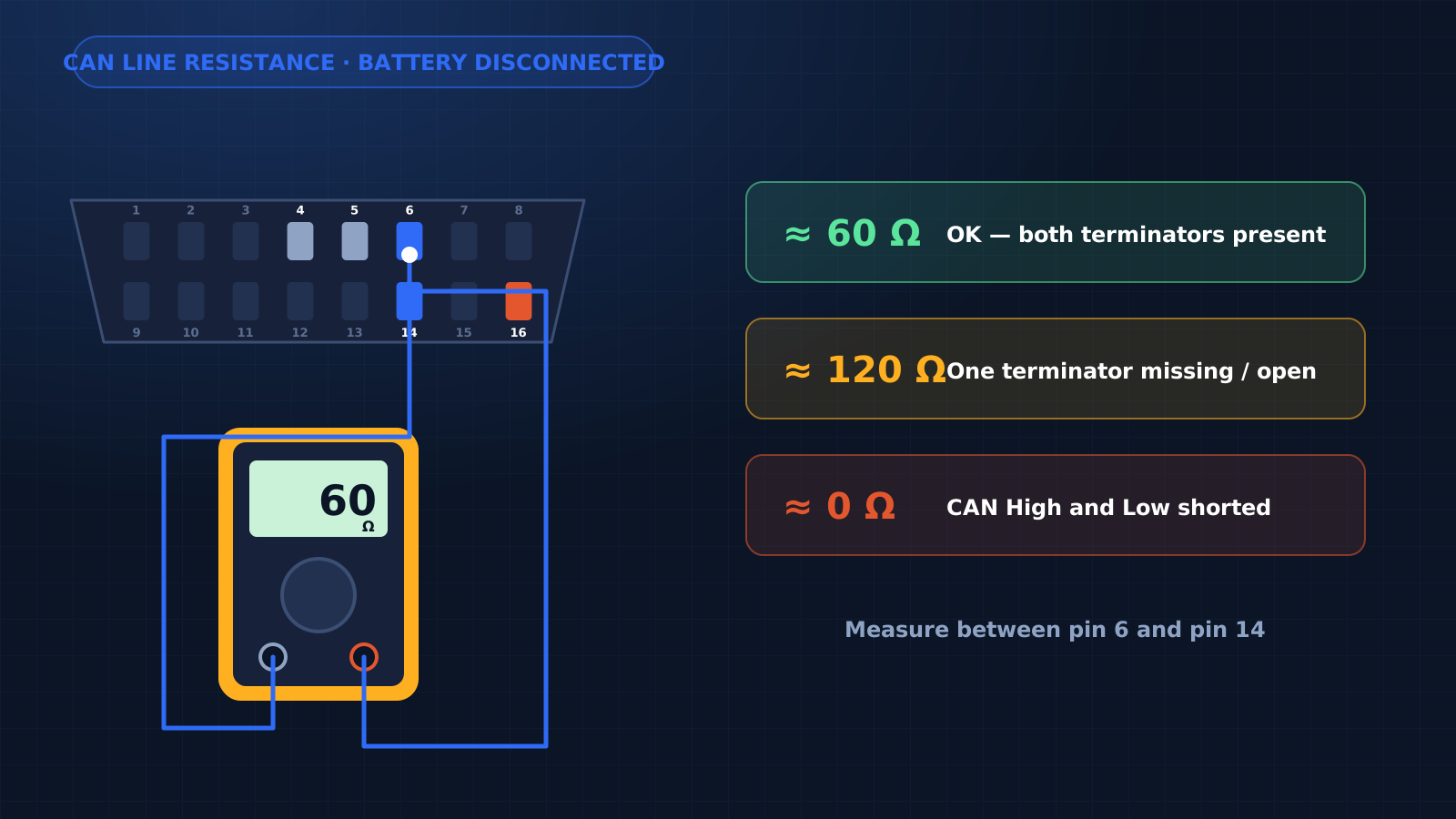
- Pin 6 to pin 14 with the battery negative removed: about 60 Ω. 120 Ω means one terminator missing or the line is open; 0 Ω means a short.
- Pin 6 and pin 14 to pin 4 with ignition ON: CAN High about 2.6–2.7 V, CAN Low about 2.3–2.4 V. 0 V or 12 V means a short to ground or supply.
- Pin 7 to pin 4 with ignition ON and the scanner unplugged: about battery voltage. 0 V means the K-line is shorted to ground.
Be careful with the socket
Do not force a thick probe into the socket. The terminal gets loose and the scanner then disconnects again and again. Use a thin back-probe pin or an OBD breakout box, and never let pin 16 touch any other pin. In many cars the OBD port fuse is shared with the cigarette lighter or power socket.
Download the free PDF
This article is based on the Garage Gyan OBD-II Pin Guide student notes. The 6-page PDF is free in Hindi, Hinglish and English at login.garagegyan.in.
Frequently asked questions
What does each pin of the OBD-II port do?
Pin 16 is battery +12 V, pins 4 and 5 are ground, pins 6 and 14 are CAN High and CAN Low, pin 7 is the K-line, pin 15 the L-line, pins 2 and 10 are J1850. The remaining pins are left to the car maker (OEM).
Which OBD pins give power to the scanner?
Pin 16 supplies battery +12 V and pins 4 and 5 provide ground. If the scanner does not turn ON, check these pins and the OBD port fuse first.
How do I know if my car uses CAN or K-line?
Look at the socket. Terminals in pins 6 and 14 mean CAN. Only pins 4, 5, 7 and 16 mean K-line. Almost all cars after 2008 use CAN.
How are OBD pins numbered?
Looking at the car socket from the front with the wide side up, the top row is pin 1 to 8 from left to right and the bottom row is pin 9 to 16 from left to right.